
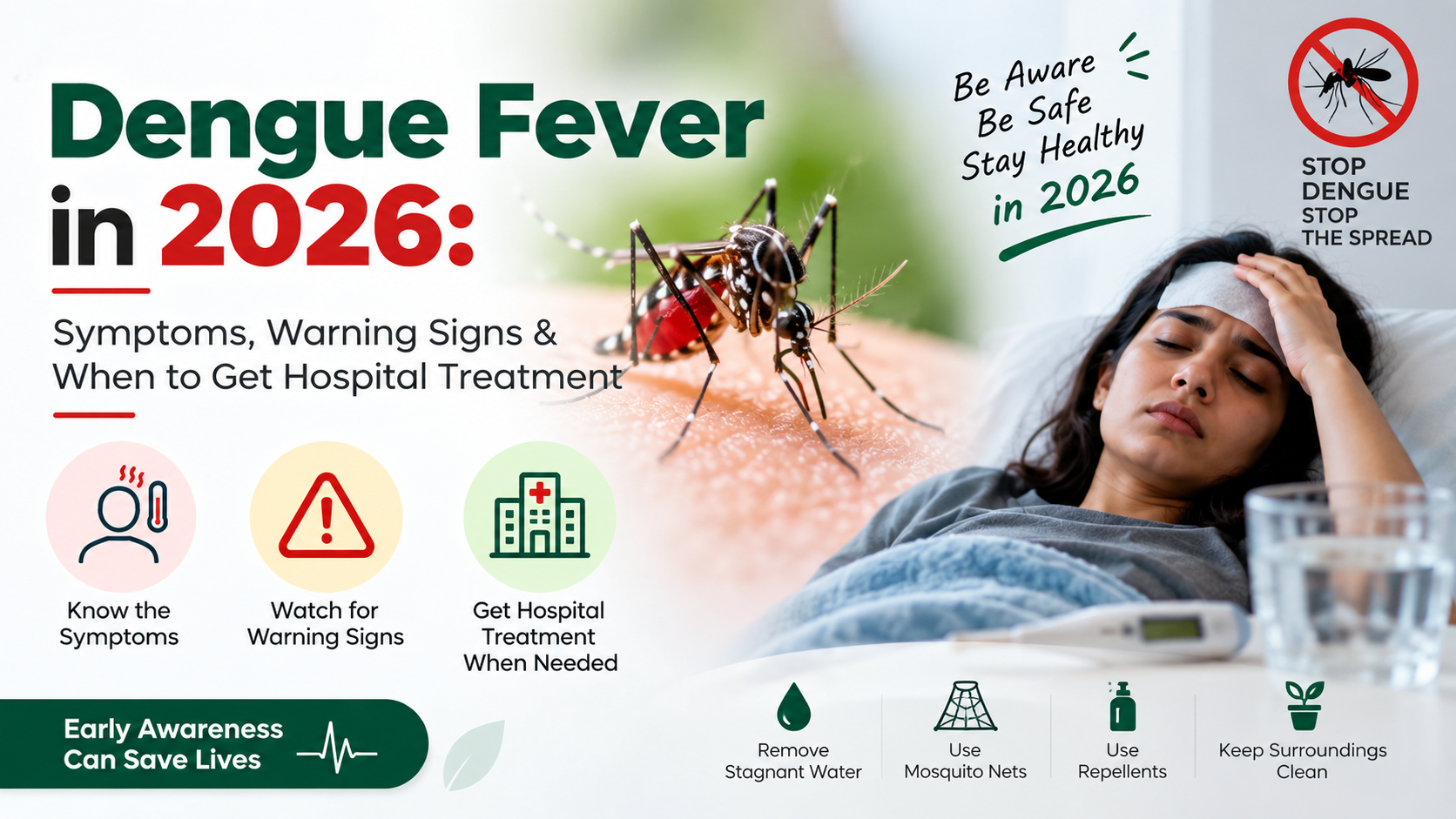
Dengue Fever in 2026: Symptoms, Warning Signs & When to Get Hospital Treatment
Most people have had dengue or know someone who has. The illness itself is not what catches people off guard. What does not recognize the point where staying home stops being the right decision. That line is harder to see when it is being crossed than it sounds.
Rest and fluids and waiting it out feels like the right call, and for most people it is. A fever that will not budge, pain settling into every joint, a rash showing up a few days later. None of them look urgent at first glance. But somewhere along the way the illness can shift into something that is no longer manageable at home, and that shift is easy to miss entirely if the right signs are not being watched for.
Let us go through the symptoms, the warning signs, and the point where hospital treatment actually becomes necessary for dengue fever, so that every person knows how to act before it is too late.
Why Dengue's Danger Doesn't Show Up Early
Dengue does not show its real face early on. Home rest, fever management, fluids, and the sense that things are under control; that is usually where it starts. The warning signs, when they finally show up, tend to arrive after the illness has already moved past where anyone expected.
Manageable dengue that needs a hospital. Not the same thing, and most people do not realize how different it actually matters.
What Dengue Fever Actually Is
An infected Aedes mosquito bite, that is how it spreads. Not person to person, never directly. Dengue never spreads directly between people. We have seen that everything comes down to the mosquito; it bites someone already infected, picks up the virus, and passes it on through whoever it bites next.
That single mechanism is behind the rising case numbers through 2026 across tropical and subtropical regions, where dengue has stayed one of the more serious illnesses mosquitoes carry. Most cases run their course alone, somewhere between a week and ten days. A smaller share turns into severe dengue. Left unrecognized, that version can turn life threatening.
The Symptoms That Show Up First
Symptoms show up four to ten days after the bite. A high fever is almost always how it starts, rising quickly to around 39 or 40 degrees Celsius. A severe headache and pain behind the eyes follow not long after. Intense joint, muscle pain, and heavy fatigue. All of it usually follows close behind.
A bad flu is what most people assume, without linking it to dengue, but mosquito exposure should always put dengue on the radar. That specific combination, high fever with severe body pain and pain behind the eyes, is one of the clearer signs of setting dengue apart from an ordinary viral fever.
Between day three and five, a rash tends to appear, typically starting on the trunk before spreading to the arms and legs. Flat red patches for some, raised spots for others. Either way, it points toward dengue rather than anything else.
The Phase That Catches Most People Off Guard
Day three to seven, that is usually when the fever starts dropping. And that is exactly when people start assuming recovery has begun. This is the part that catches most people off guard. Falling fever does not always mean things are getting better. Sometimes it marks the start of the critical phase instead, the stretch where complications are most likely to show up.
Fluid can leak from blood vessels during this window; platelet counts can drop fast, and bleeding risk climbs. At home, there is usually no way to notice any of this happening internally until symptoms turn severe enough to be obvious. Which is exactly why the warning signs for this phase matter as much as they do.
Warning Signs That Mean Hospital Treatment Is Needed
Some warning signs should never be handled at home. If any of these show up, hospital treatment needs to happen right away.
Persistent vomiting or severe abdominal pain is usually the first thing that signals the illness has moved somewhere it should not be managed at home.
When platelet counts fall far enough, bleeding becomes the visible sign. Nose, gum, urine, or stool. Any of these should not be ignored.
Breathing that turns rapid or labored. Can mean fluid building up around the lungs or chest.
Fatigue rest does not touch, along with restlessness or agitation. Signs that the body is struggling to hold circulation steadily.
Skin turns cold or clammy. The pulse has gone weak and rapid. A pale look. All pointing toward shock, a medical emergency needing care right away.
Blood in the vomit. Always a reason to treat it as an emergency, never to wait it out at home.
What Helps During the Non-Critical Phase
Without any of those warning signs, home management stays fairly simple. Rest and steady fluids matter more than anything else. Dehydration makes everything worse and makes the critical phase, if it happens, harder for the body to handle.
Paracetamol works fine for fever and pain. Aspirin, ibuprofen, and other anti-inflammatory medications should be avoided completely. They push up the bleeding risk. People usually reach for whatever pain relief is nearby without thinking about how it interacts with dengue specifically, but this is one detail that matters more than it looks like it should.
Watching closely for any of the warning signs above is the other half of managing dengue at home. The moment one shows up, hospital treatment should follow without delay.
When to Get Hospital Treatment
Hospital treatment becomes the right call if any of these apply.
Severe abdominal pain. Vomiting that will not stop.
Any bleeding, nose, gums, urine, or stool.
Rapid or difficult breathing.
Cold, clammy skin. A weak, rapid pulse.
Blood in the vomit.
The patient is an infant, elderly, or already managing other health conditions.
Platelet counts drop noticeably during monitoring.
Consult a doctor at the earliest even if everything else still seems manageable.
Conclusion
Dengue is common today. Cases are still rising through 2026 across large parts of the world. Anyone can be affected regardless of how normal everything seems on the surface. The best way to avoid reaching a serious stage is quite simple.
Recognizing the symptoms, catching the warning signs early, and getting to a hospital the moment those signs show up, that combination is what actually makes the difference. Dengue treated at the right time consistently ends better than dengue treated too late.
FAQ
1. What are the first symptoms of dengue fever?
High fever, severe headache, and pain behind the eyes. Joint and muscle pain are the first symptoms of dengue fever.
2. When does dengue become dangerous?
Day three to seven, once the fever starts dropping. The critical phase, complications are most likely here. Warning signs should never be ignored.
3. What are the warning signs that need hospital treatment?
Severe stomach pain, bleeding from anywhere, breathing difficulties, cold skin, weak and fast pulse. These are not symptoms to sit on. A hospital is where they need to be assessed.
4. What should be avoided during dengue fever?
Aspirin and ibuprofen make bleeding worse during dengue. Paracetamol is what should be used instead of fever and pain.
5. How is dengue fever treated in hospitals?
No specific antiviral exists for dengue. Hospitals focus on fluids, platelet monitoring, and managing whatever complications come up.