
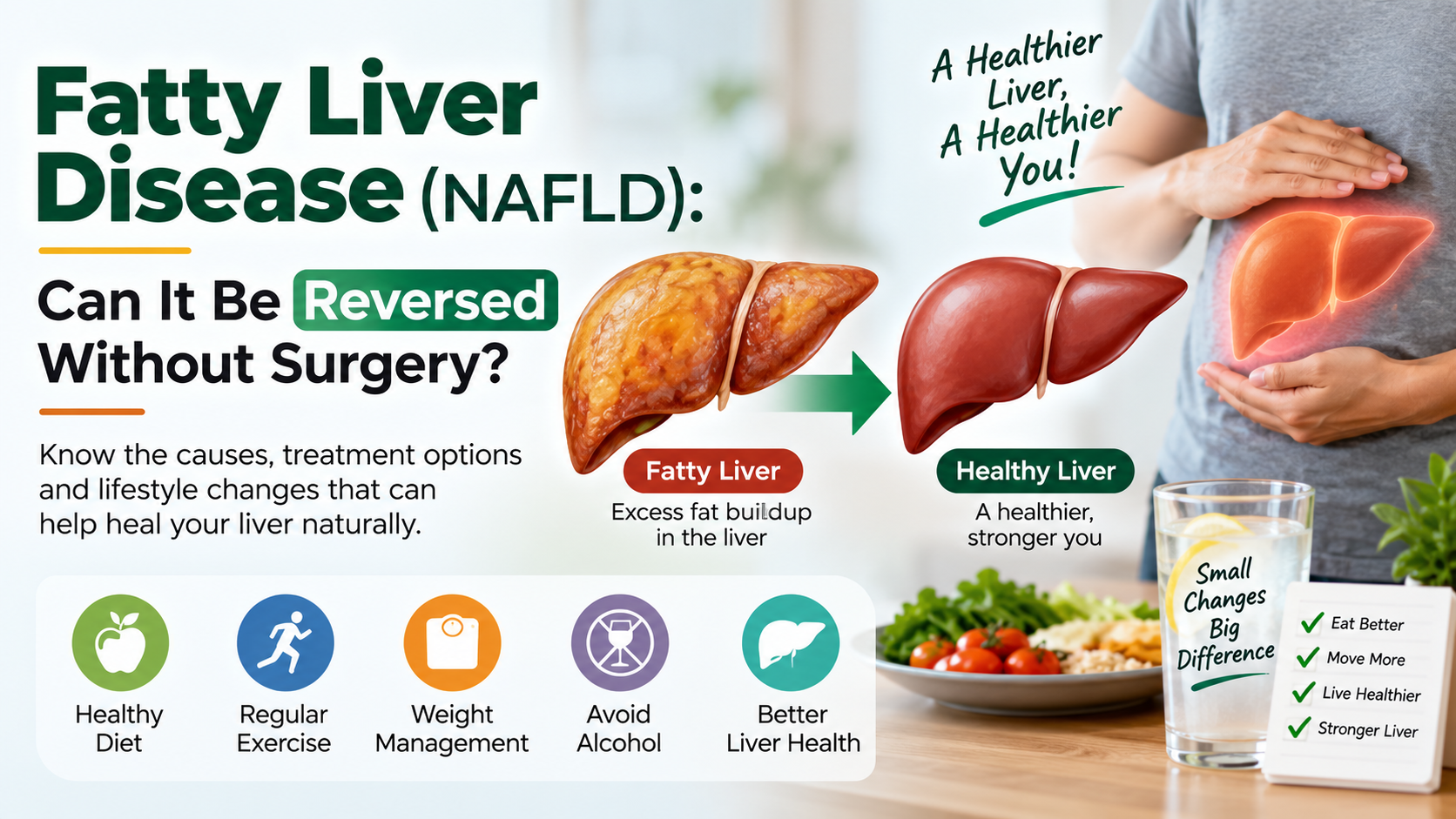
Fatty Liver Disease (NAFLD): Can It Be Reversed Without Surgery?
Fatty liver gets diagnosed all the time now. Most people walk out of that appointment still not sure what it actually means, or what they can even do about it. Most assume there is only one direction this can go in. That the diagnosis is permanent. That lifestyle is too set to change enough to make a real difference. All these things are easily ignored. What feels like a permanent condition might be something the body can reverse. And what seems like an inevitable progression might just be something that can be stopped without any surgical intervention.
Today, let us understand fatty liver disease and whether it can be reversed without surgery so that every person can take the right steps before time and avoid any uncertain circumstances.
What Fatty Liver Disease Actually Is
Nonalcoholic fatty liver disease. Fat building up in the liver, no alcohol involved. Doctors see it constantly now. One of the more common liver conditions out there. And the numbers keep climbing as obesity, and type 2 diabetes rates go up too. Daily habits rarely get connected to liver health in most people's minds, but poor diet and low activity, carried on long enough, quietly let fat build up in the liver with no obvious warning along the way.
NAFLD exists on a spectrum. At one end is a simple fatty liver where fat is present, but there is no significant inflammation or damage. At the other end is a more serious stage called NASH where inflammation and liver cell damage are present. People usually do not realize how serious NASH can become, but if it continues for a longer period of time without being addressed, then it can lead to fibrosis, cirrhosis, and in some cases liver failure.
Can It Actually Be Reversed
NAFLD can in most cases be reversed without surgery, particularly when it is detected at an earlier stage. The liver is one of the few organs in the body that has a genuine capacity to heal itself when the right conditions are created. People usually assume that a liver condition is something that can only be managed without thinking about what is possible, but if the right lifestyle changes are made consistently for a longer period of time, then significant improvement is possible.
Simple fatty liver and early-stage NASH respond well to lifestyle changes. More advanced stages are significantly harder to reverse, and if the condition has been allowed to progress for a longer period without any attention, then the options become more limited. This is why early detection and early action make such a significant difference.
What Causes Fatty Liver Disease
There are certain causes of fatty liver disease that are important to understand. Some of these are listed below.
Refined carbohydrates, added sugars, processed foods, saturated fats, and poor diet built around these are one of the most seen causes of fatty liver. People usually do not connect what they eat to their liver health at all, but if these habits continue for a longer period of time, then fat accumulation in the liver becomes a real risk.
Obesity and excess weight are also among the most seen causes. People usually do not connect their weight to their liver health without thinking about the impact, but if excess weight continues for a longer period of time, then it can significantly increase the risk.
Physical inactivity is also one of the causes. People usually ignore the impact of a sedentary lifestyle on liver health, but if physical activity remains low for a longer period, then it can increase the risk of developing and worsening fatty liver disease.
How It Can Be Reversed Without Surgery
To avoid reaching a difficult stage, the right steps should be taken as early as possible. Some of these are listed below.
Weight loss is the most significant factor. People usually underestimate how much of a difference even a modest amount of weight loss can make, but if five to ten percent of body weight is lost consistently over a longer period then it can lead to meaningful reductions in liver fat.
Dietary changes are also one of the most effective ways to change. The Mediterranean diet is one of the most studied and most effective dietary approaches for NAFLD. People usually do not connect their dietary habits to their liver health without thinking about the impact, but if a diet rich in vegetables, whole grains and healthy fats is followed consistently for a longer period of time then it can make a significant difference.
Physical activity is also one of the most effective ways to improve liver health independently of weight loss. People usually ignore this but if moderate intensity aerobic exercise is practiced consistently for a longer period of time, then it can make a significant difference to liver fat levels.
Sleep quality and stress management are also important. People usually do not connect poor sleep and chronic stress to liver health, but if these are not addressed alongside diet and exercise, then they can work against the improvements being made.
When to Visit a Doctor
People often ignore visiting a doctor or even keeping a check on early signs of fatty liver disease. It is better to consult a doctor if any of the following situations apply.
If liver enzyme levels have been elevated without any clear reason for a longer period of time. If there is persistent fatigue or abdominal discomfort alongside a known diagnosis. If lifestyle changes have been made but there has been no improvement after a reasonable period of time. Consult a doctor at the earliest even if everything else still seems manageable.
Conclusion
Fatty liver disease is a condition which is very commonly seen today, and the cases continue to rise alongside rising rates of obesity and metabolic disease. This can happen to anyone at any time even if everything seems normal from the outside. The best way to avoid such things happening is quite simple.
Getting the diagnosis right and then acting on it without delay; that combination is what actually changes the outcome, not just knowing the condition exists. Given the right conditions, the liver can genuinely repair itself. Acting early and staying consistent with it tends to produce far better results than waiting for things out.
FAQs
1. Can fatty liver disease be reversed without surgery?
Yes. Most people assume it is a permanent condition, but that is not always the case. Sustained lifestyle changes have been shown to genuinely reverse it, particularly when the condition is caught before it has progressed too far.
2. How much weight loss is needed to improve fatty liver disease?
Five to ten percent of body weight is the range where meaningful improvement tends to happen. It has to be maintained consistently though rather than lost and regained for the liver to actually benefit.
3. What diet is best for fatty liver disease?
The Mediterranean diet is one of the most studied and effective approaches. People usually follow poor dietary habits without connecting them to liver health, but if dietary changes are made consistently, then the improvement in liver fat levels is significant.
4. Does exercise help fatty liver disease even without weight loss?
Yes. Moderate intensity exercise, kept up regularly, can improve liver health on its own, even in the absence of any real weight loss.
5. When does fatty liver disease need medical treatment beyond lifestyle changes?
When lifestyle changes have not produced improvement after a reasonable period of time. It is always better to consult a doctor rather than managing the condition without proper medical oversight.