
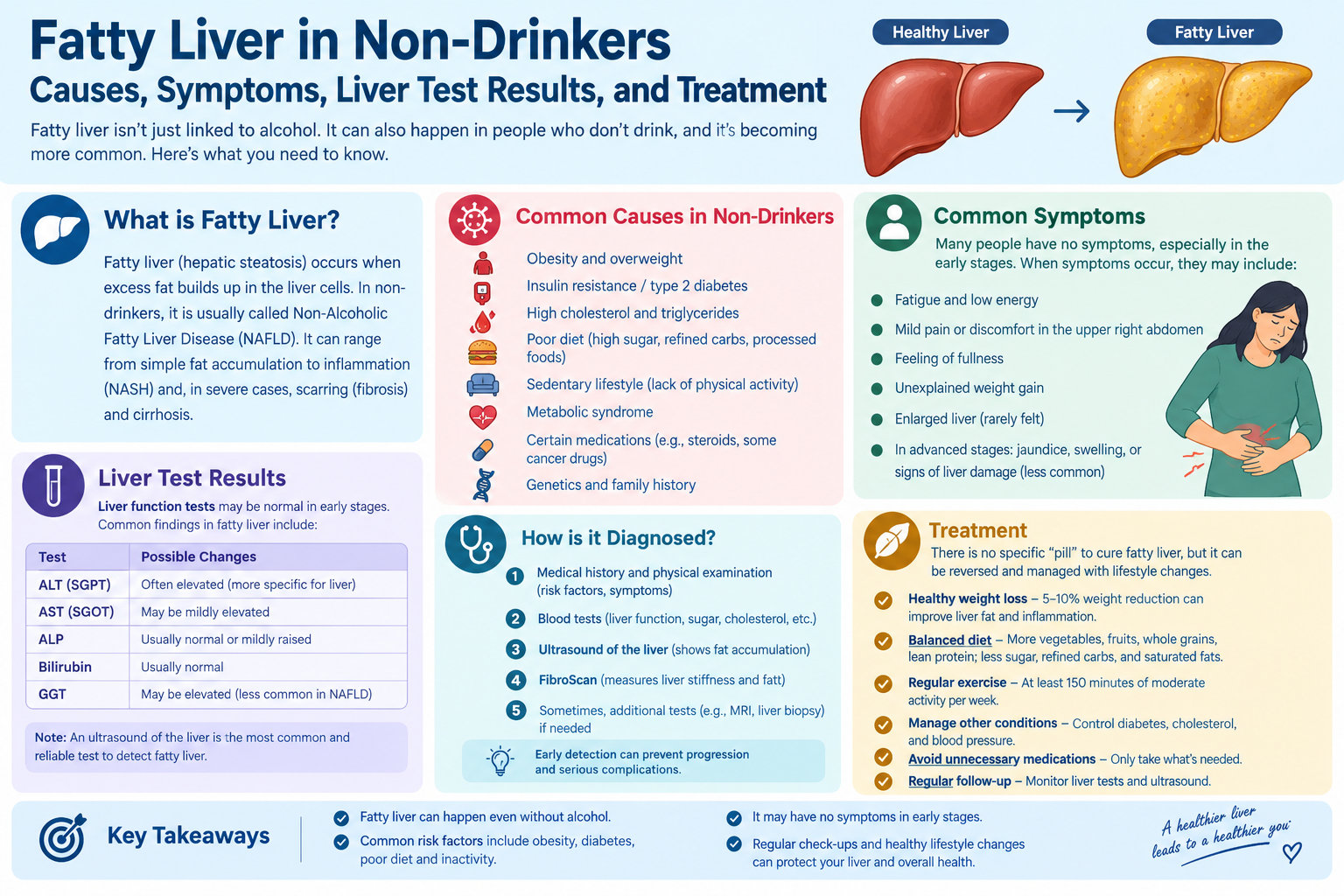
Fatty Liver in Non-Drinkers: Causes, Symptoms, Liver Test Results, and Treatment
A person hears "fatty liver" and thinks that it is caused by alcohol. This is a wrong assumption more often than one would think. Many cases are not due to drinking, but to fat and sugar metabolism in the body, and this condition has become so prevalent that it is now considered one of the most common liver disorders in the world.
What the Diagnosis Actually Means
For years, doctors have been using the term non-alcoholic fatty liver disease (NAFLD) to distinguish it from liver damage from excessive drinking. This name was changed in 2023. After deliberation, major liver associations agreed on metabolic dysfunction-associated steatotic liver disease (MASLD), as it is not a "no alcohol" disease, but is a liver disease that is associated with metabolic dysfunction. The same imbalance that leads to type 2 diabetes and high cholesterol is responsible for MASLD: how the body processes energy.
The disease begins with a simple onset. Fat builds inside liver cells until it makes up more than five percent of the organ's weight. Initially, this fat does little harm. Over time, some cases progress to the next stage, referred to as metabolic dysfunction associated steatohepatitis (MASH), also referred to as NASH. When it comes to scarring, MASH can be a serious risk, and recurring scarring can lead to cirrhosis.
What Drives Fat into the Liver
Most often, it's due to insulin resistance. The cells become unresponsive to insulin, so the body makes more, and the excess insulin causes the liver to store fat, rather than burn it off. This is the same mechanism that causes the development of Type 2 diabetes and is why Type 2 diabetes is often associated with Type 1 diabetes. Over 50% of Type 2 diabetics have some degree of fatty liver disease.
Weight is also important, particularly if it's in the tummy, but the disease doesn't just affect people who are overweight. Many cases are arriving at a very normal BMI, typically related to visceral fat or genetics, and not to the appearance of a scale. One gene variant, PNPLA3, has been associated with weight loss and weight gain irrespective of how much weight is gained or lost.
Some other conditions increase the risk. Polycystic ovary syndrome and both elevated triglyceride and low HDL levels, which are also associated with metabolic syndrome, both contribute directly via the insulin resistance pathway. An underactive thyroid and obstructive sleep apnea show similar links. Some medications, such as certain types of corticosteroids and tamoxifen, can lead to fat accumulation and rapid weight loss, especially following some types of bariatric surgery, can temporarily exacerbate liver fat until overall health improves.
Why Most People Never Notice Anything
In most individuals, fatty liver is not accompanied by pain or a noticeable change to alert us to the condition. It usually is discovered incidentally when it is scanned for other reasons. When symptoms do manifest early, the symptoms are easy to overlook not being able to get out of bed, a dull pain below the right ribcage, pain after a large meal.
During the later stages of the disease, when fibrosis is more advanced, or MASH has occurred, the picture is different. Loss of weight without cause, swelling of the legs or abdominal organs, yellowing of the skin or eyes, and itching of the skin for no known reason. None of these are to be ignored during a routine checkup, and all indicate advanced liver involvement.
Reading Liver Test Results
Elevated levels of ALT and AST are generally the first sign of fatty liver and will be detectable on a routine blood panel. If early and simple fatty liver is detected, the ALT level is elevated compared to the AST level. As the fibrosis progresses to cirrhosis, the pattern reverses, and AST increases level over ALT. However, enzyme numbers can be completely normal in the presence of obvious fat accumulation; a normal blood test does not rule out the diagnosis.
Imaging fills in what blood work can only hint at. A fatty liver appears brighter than normal on the abdominal ultrasound, which is called hyperechoic by radiologists. If you're interested in learning more about scarring, there's a test called transient elastography or Fibro Scan that measures how stiff your liver is and can be offered at many clinics. A liver biopsy remains the most definitive type of test because it directly assesses the amount of fat, inflammation, and scarring in the liver and is only used when there is real uncertainty about the liver's condition based on the noninvasive tests.
Doctors complete this with fasting glucose, HbA1c (a blood test that reveals how well blood sugar levels have been controlled over the past three months), and lipid panel (which measures cholesterol and triglycerides levels). The platelet count contributes to the FIB-4 index which is a simple formula based on age, AST, ALT, and platelets that helps to estimate fibrosis severity without a biopsy.
What Actually Helps
Lifestyle change is more effective than any other treatment that's available for this disease. Losing up to 10% of body weight has been shown to decrease liver fat, and this same weight loss range improves inflammation and early fibrosis as well. A diet focused on vegetables, whole grains, lean protein and healthy fats, which is similar to the Mediterranean diet, is better than diets that simply reduce calories. Exercise is a treatment in itself, not dependent upon weight loss, and studies uniformly demonstrate that aerobic exercise combined with resistance training leads to the best results.
The conditions that bring the disease are also a factor to be addressed. When blood sugar and cholesterol levels are kept within a healthy range, the liver does not have to work as hard to get rid of fat, and alcohol, even in moderation, is another burden on an already overworked liver.
There have been recent advances in drug treatment. In March 2024, the FDA approved resmetirom, the first drug approved specifically for the treatment of MASH with moderate to advanced fibrosis, in addition to diet and exercise. Vitamin E sometimes is recommended to non-diabetic patients with known MASH, and in this subset, it has been shown to benefit liver tissue. Newer drugs, called GLP-1 receptor agonists, were originally developed for diabetes and weight loss but have a beneficial effect on the liver in those who are eligible.
When a Doctor Visit Should Not Wait
Even if there are no symptoms, certain individuals with risk factors such as obesity, type 2 diabetes, or high cholesterol should consider having periodic liver screening. An elevated liver enzyme or a fatty liver diagnosed at ultrasound or if there is any evidence of advanced disease (including jaundice and unexplained swelling) should be discussed immediately with a doctor and not left for the time being.
FAQs
1. Is it possible to get a fatty liver without ever consuming alcohol?
Yes. MASLD, or NAFLD as it was previously known, develops due to the metabolic factors and does not require any alcohol consumption.
2. Can fatty liver in non-drinkers be cured?
Yes. Lifestyle changes such as losing weight, diet and regular exercise, can make a significant difference to liver fat and can reverse early liver damage before significant scarring occurs.
3. Does fatty liver disease occur in a normal weight person?
Yes. In many instances, a true portion of cases are discovered in individuals who have a standard body mass index, possibly due to visceral muscle fat, genetics, or perhaps insulin resistance which has no visible signs.
4. Is severity of fatty liver always reflected by liver enzymes?
No. If there is some fat buildup in the normal way, the enzyme can still read that as well, and so imaging or elastography will often provide a better indication of the severity of the disease.
5. Should liver function be monitored regularly in a person with the risk factors of diabetes?
Recommendations for liver testing and imaging vary by year, depending on the presence of diabetes, obesity or metabolic syndrome and the patient's specific risk profile, as determined by a doctor.