
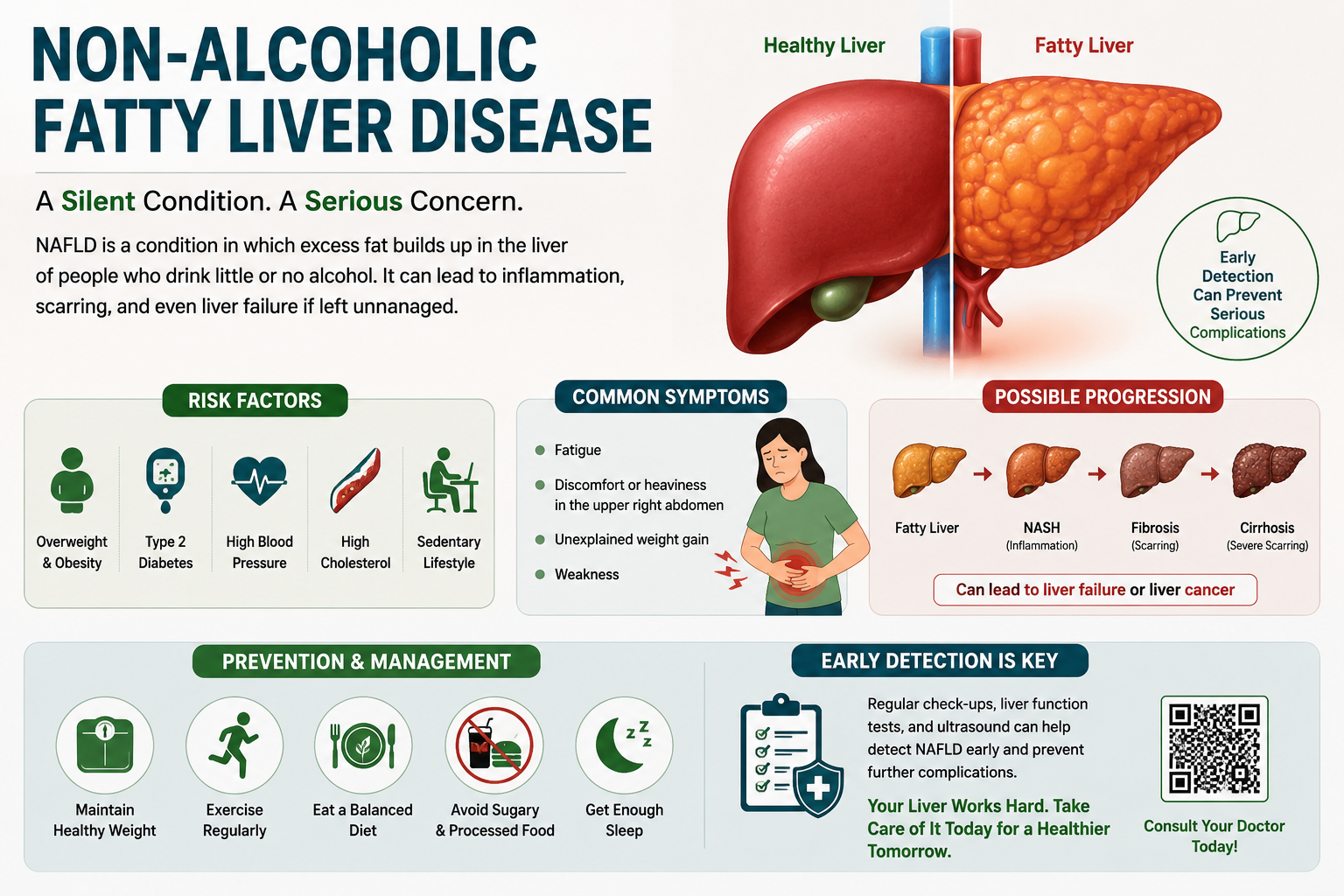
Non-Alcoholic Fatty Liver Disease in Young Adults: A Growing Health Concern
Many people in their twenties and early thirties have fatty liver disease and don’t realize it. Previously, it was seen mainly in the elderly and associated with years of alcohol abuse. That's changed. Now clinicians are catching on to individuals who consume little or no alcohol, typically by chance, during a blood test that was ordered for some other reason.
Constant tiredness which doesn't go away, dull pain under the right ribs that is attributed to posture or stress. Blood tests which return slightly abnormal and are falsely labeled as "no big deal." All this is swept under the rug more frequently than it should be.
Let's learn about what NAFLD is, why it is increasing in younger generations, and the importance of early intervention.
The Stage Most People Miss
Most people come to know about fat when it has been accumulating for years. No one feels it's happening. It's not like there is a moment when it changes from good to bad; it's always a gradual slide that only an examination or blood test can detect.
Early accumulation of fat does not reverse itself just because it's caught. However, early diagnosis can alter the course of events, more than one would think.
Non-Alcoholic Fatty Liver Disease- What is it?
In a person who rarely or never drinks alcohol, it's the buildup of fat in liver cells. A small amount of fat in the liver is okay. However, if it compromises 10% or more of the total liver weight, it is considered a fatty liver.
In its initial stage, known as simple steatosis, the liver accumulates excess fat with little else occurring. People typically think that is the end of the story, but when left untreated for an extended period of time, it may progress into inflammation and scarring called steatohepatitis.
Since it is more driven by metabolic problems than alcohol history, doctors have begun using a new term for this: metabolic dysfunction-associated steatotic liver disease, or MASLD. The older term NAFLD is still used everywhere and is synonymous with the meaning.
Why It's Showing Up in Young Adults Now
1. Rising Insulin Resistance and Obesity
This is the largest part of it. If the body is not sensitive to insulin anymore, it might deposit additional fat in the liver rather than utilize it. When people think of insulin resistance and think of blood sugar and diabetes, they don't think of the liver, but it's all related.
2. Diet Heavy in Sugar and Processed Food
The liver may not be able to keep up with the rate at which it converts sweets, processed food, refined carbohydrates, and extra sugar into fat. The fat doesn't have much of a place to go if you have a desk job or time spent in front of the screen.
3. Genetics
Not everyone with a rough diet ends up with a fatty liver, and not everyone who has it is overweight. A gene variant called PNPLA3 seems to make some people store liver fat more easily than others, regardless of body size. There's a family history component as well.
Why It Stays Hidden So Long
Often, fatty liver disease does not cause any symptoms. Most people are fine in the early stages, possibly a little tired, nothing that would indicate liver disease. Young adults do not regularly have their liver checked unless there is a reason for it, so it just sits there.
It will generally be revealed when a person's routine blood test results include slightly elevated ALT or AST. It's the silent, symptom-free stretch that makes this difficult. When real symptoms become evident, significant damage may already have been done.
How Doctors Actually Diagnose It
The initial test is typically a blood test to evaluate liver enzymes (ALT, AST). Normal numbers don't completely rule it out, so an ultrasound is usually performed afterwards, as fat is not difficult to see in the liver.
Some doctors use transient elastography to examine how hard the liver has become an indicator of scarring if a closer examination is needed. When there is genuine uncertainty, the most reliable method is to perform a biopsy, but this is not performed unless necessary.
What Happens If Nothing Changes
Most people with simple fatty liver never progress further. If it's not treated, it can get worse from steatohepatitis to fibrosis and, in severe cases, from fibrosis to cirrhosis. It also increases risk for cardiovascular disease because the same metabolic disturbances that contribute to liver fat increase risk for cardiovascular disease as well.
What Actually Helps
This is a good part of the fact that early state fatty liver is truly reversible. Even losing weight by seven to 10 percent over a period of time has been proven to significantly reduce liver fat. It doesn't have to be drastic. It's always better to make gradual changes than crash diets.
All of this adds up to reducing added sugar, increasing whole foods and fiber, and regular exercise – even a walk. It's not an alcohol issue, but reducing alcohol does relieve liver strain.
In more severe situations, doctors may directly treat the other conditions that may be present, such as diabetes or high cholesterol, as both can make things slower. In recent years, an agent for scarring of the liver associated with this disease has also become available, but it is normally only used in more severe cases, in specialist care.
When to See a doctor
If you have extra weight, an inactive lifestyle, type 2 diabetes, or a family history of liver issues, it's worth talking to a doctor, even if you don't have symptoms. A general tiredness, a dull pain under the right ribs or a liver number that came back off on a random test; none of that should be swept aside and forgotten. Worth chasing down.
FAQs
1. Can you have fatty liver disease without being overweight?
Yes. Genetics and insulin resistance can cause it even at a normal weight. Doctors sometimes call this lean NAFLD.
2. Can fatty liver disease be cured?
Early on, it can be reversed. Losing weight and improving food intake will reduce liver fat in a true sense. Once it's reached advanced fibrosis or cirrhosis though, that's a much harder thing to undo.
3. What blood tests show fatty liver disease?
It typically begins with elevated ALT and AST levels, although these levels are not conclusive. Most doctors will use that in conjunction with an ultrasound to determine what is happening.
4. Does fatty liver disease hurt?
Not at first, no. This is usually a less prominent symptom and will appear later on instead of earlier; some people will experience a dull ache under the right rib, but this is not always a major symptom.
5. Can a healthy diet still lead to fatty liver disease?
It's less common, but it happens. It doesn't have to be a hereditary problem or insulin resistance that gets people moving.