
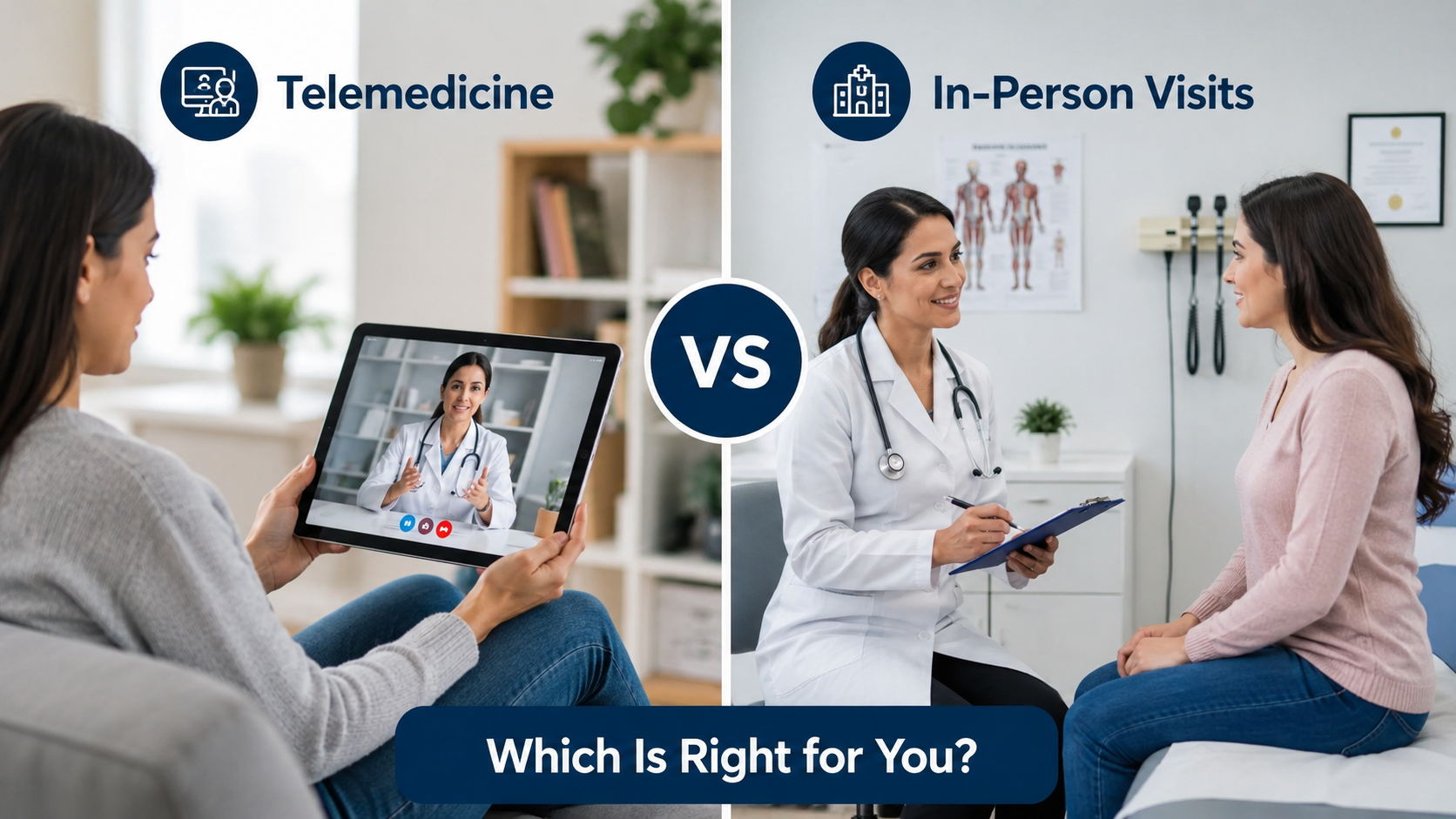
Telemedicine vs In-Person Visits: Which Is Right for You?
Telemedicine and in-person visits are options which are very commonly available today, but choosing between the two is something most people find difficult. Most people who need medical attention are not sure which option is right for their situation. A minor cold, a follow up consultation, a new symptom that needs examination. All these signs are easily ignored.
What feels like a minor issue that can be handled over a call might actually need a doctor to look at in person. And what seems like a clinic situation might actually be something a quick call with a doctor can sort out.
Telemedicine and in person visit both have their place, and knowing which one fits a situation is what helps in the long run.
The Two Options Are Not Always Easy to Tell Apart
Most people do not sit down and think this through. The choice just gets made into habit, not on what the situation actually calls for. The wrong choice gets made, and by the time anyone realizes, things have already gotten worse.
The difference between the two options is what every person needs to understand before making that choice.
What Is Telemedicine?
Telemedicine is a way of consulting a doctor remotely through a phone or video call without visiting a clinic. It is one of the most commonly used healthcare options today. People usually do not think about whether telemedicine is the right option for their situation without considering the impact, but if the wrong option is chosen for a longer period of time, then it can lead to delays in getting the right care.
Telemedicine works well for certain situations. Following up visits, prescription renewals, minor illnesses and mental health consultations are some of the most seen examples. People usually do not consider telemedicine without thinking about how much time and effort it saves, but if it is used for the right situations then it can make a big difference over time.
What Is an In-Person Visit?
An in-person visit is a traditional consultation where a patient visits a doctor at a clinic or hospital. It is still the most commonly recommended option for certain types of medical situations. There is a habit of assuming an in-person visit is always the safer route, even in cases where telemedicine would have done the job just fine. That said, in some situations do call for a doctor to actually be in the room with the patient.
Physical examinations, diagnostic tests, emergencies and symptoms that have never been looked at before all fall into this category. Signs are not always possible to assess remotely, and if an in-person visit is delayed for a longer period of time in situations that require it, then it can lead to bigger issues.
When Telemedicine Is the Right Choice
There are certain situations where telemedicine is the most appropriate option. Some of these are listed below.
Minor illnesses like colds, coughs, and mild fever that do not require physical examination are some of the most seen situations where telemedicine works well. People usually ignore the convenience of telemedicine without thinking about how much time it saves, but if it is used consistently for the right situations, then it can make a significant difference.
Follow up consultations for ongoing conditions are also well suited to telemedicine. People usually come in for follow up visits in person without thinking about whether it is necessary, but if the condition is stable and no physical examination is needed then telemedicine is just as effective.
Mental health consultations are also one of the situations where telemedicine works very well. People usually ignore this option without thinking about the impact, but if mental health consultations are conducted through telemedicine consistently then it can make accessing support significantly easier.
Prescription renewals for existing medications are also something that can be handled through telemedicine in most cases. People usually visit a clinic in person for prescription renewals without thinking about whether it is necessary, but if the condition is stable, then telemedicine is a perfectly appropriate option.
When an In-Person Visit Is Necessary
There are certain situations where an in-person visit is necessary, and telemedicine is simply not enough. Some of these are listed below.
New symptoms that have never been assessed before need a doctor to look at them properly. A physical examination cannot be replaced by a video call and if this is delayed, then it can lead to a situation that is harder to manage later.
Emergency situations like chest pain, difficulty breathing, or severe injury are conditions where telemedicine is simply not an option. If these symptoms are present, immediate medical attention should be sought without any delay.
Diagnostic tests and procedures that require physical presence are also situations where an in-person visit is necessary. Blood tests, X-rays, and ultrasounds cannot be conducted through telemedicine, and if these are required, then an in-person visit should be arranged without delay.
When to Visit a Doctor in Person
Telemedicine gets pushed as the default sometimes, even when the signs pointing toward an in-person visit are right there. Visiting a doctor in person is the better call if any of the following apply.
- A new symptom has appeared that has never been assessed before.
- Chest pain, difficulty breathing, or any symptoms that could indicate a serious condition is present.
- Telemedicine consultations have been tried, but the condition just is not getting better.
- The patient is a young child, or an elderly person dealing with complex medical needs.
- Even if things still seem manageable on the surface, it is worth seeing a doctor in person as soon as possible.
Consult a doctor in person at the earliest even if everything else still seems manageable
Conclusion
Telemedicine and in-person visits are options which are very commonly available today, and both have their place in modern healthcare. This is a decision that every person has to make at some point even if everything seems straightforward from the outside. The best way to make the right choice is quite simple.
Knowing which route fits the situation, then actually acting on it at the right moment, and not delaying an in-person visit when one is genuinely needed, that is where the real difference lies. A health condition deserves attention, but so does the decision around how to handle it. Choosing early almost always pays off in the end.
FAQs
1. What is telemedicine?
Consulting a doctor over the phone or video instead of visiting a clinic. Works well for minor illnesses, follow-ups, prescription renewals, and mental health consultations.
2. When should telemedicine be used?
For minor illnesses, follow-ups, prescription renewals, and mental health consultations. If no physical exam is needed, telemedicine works fine.
3. When does an in-person visit necessary?
For new symptoms, emergencies, diagnostic tests, and complex medical conditions. These should not be delayed.
4. Is telemedicine as effective as an in-person visit?
For the right cases, yes. Physical exams and diagnostic tests still need an in-person visit.
5. Is telemedicine safe?
Yes. Telemedicine is a safe and effective option for appropriate medical situations. It is always better to confirm with a doctor whether telemedicine is the right option for a specific situation rather than assuming.