
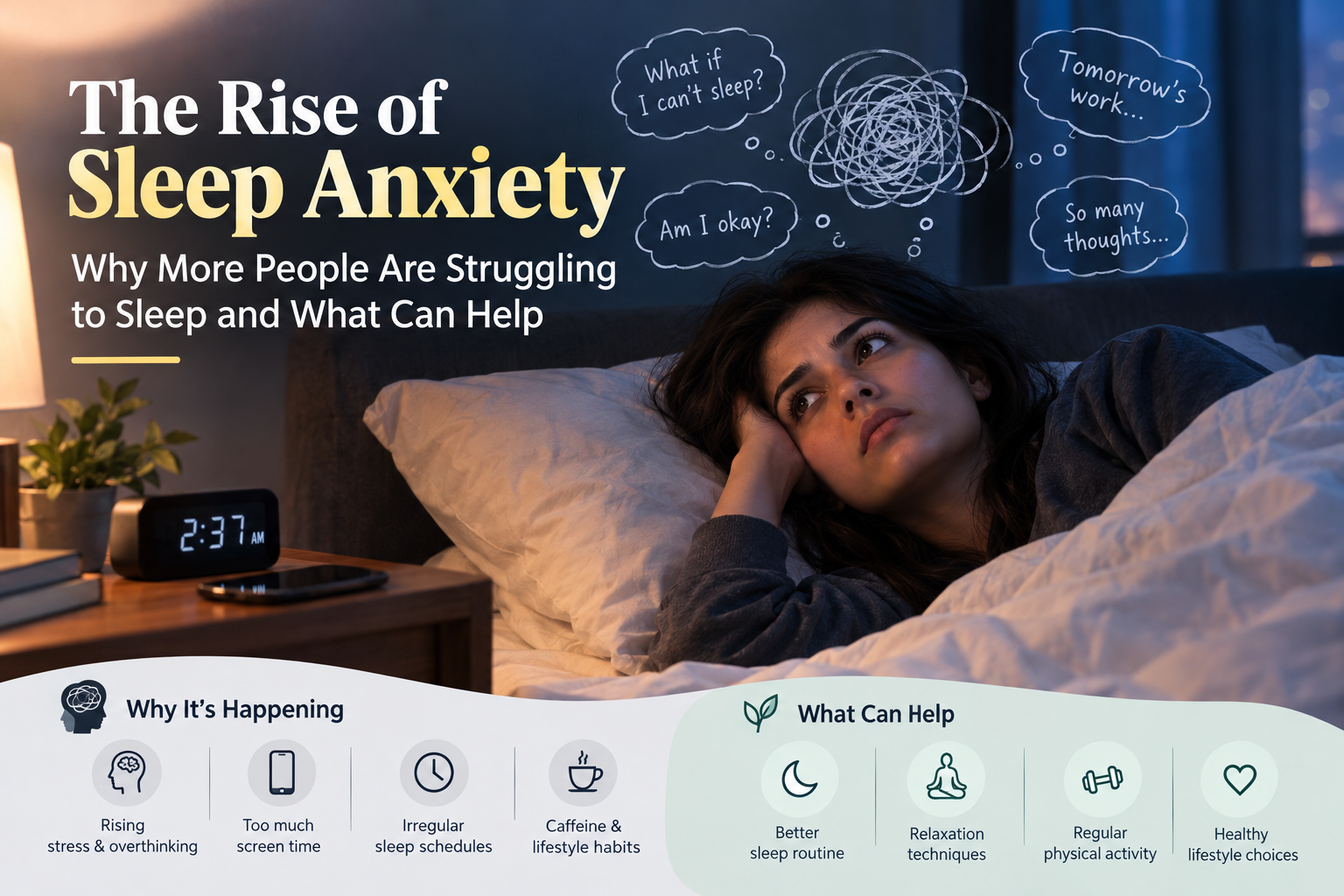
The Rise of Sleep Anxiety, Why More People Are Struggling to Sleep and What Can Help
Lying awake at 2 a.m. calculating exactly how many hours of sleep are still possible, then feeling the calculation itself become the thing keeping you awake, is a specific kind of frustration a lot of people know well. It's not always classic insomnia. Often, it's something closer to a fear of not sleeping, one that makes falling asleep even harder than it already was.
This trend is now beginning to be explicitly identified by sleep scientists, and the statistics behind it can't be ignored. Neighboring almost 40 percent, one recent study revealed that Gen Z adults are experiencing sleep-related anxiety at least three times weekly, up from previous years. There has been a change in the attitudes of people towards sleep, and it is important to know why, as the reasons are more specific than "modern life is stressful."
What Sleep Anxiety Really Is
Sleep anxiety is the fear of sleep, either about falling asleep, staying asleep or waking up feeling exhausted to perform. It's different from a normal state of anxiety in one significant respect. The anxious thought is the thing that's anxious, and they are the same activity, thus making it very difficult to break the loop.
A less severe form of insomnia could be that one or two nights here and there are not very restful and do not have a lot of emotional content. Then there's sleep anxiety, with fear added to all that, and can begin long before even the bedtime bell rings. A person could feel a tightness in their chest at 8 P.M. just before going to sleep, before they even try to go to sleep, because they know it's going to be a bad night.
This is a kind of anxiety that is anticipating, and because of this, sleep anxiety is more difficult to manage with the same advice that is given for other anxiety disorders. The tired, overworked nervous system is already on guard for a poor night of sleep with instructions to "just relax before bed."
Why It's Becoming So Common
The Orthosomnia Problem
Sleep tracking devices were supposed to help people sleep better, and for some, they do. They've made a problem for others. Because of the preoccupation with perfect sleep scores, researchers have come up with the term orthosomnia to describe the unhealthy way of looking at the data from a sleep tracker as a source of anxiety.
The irony here is well documented. People with normal, healthy sleep architecture on clinical testing still report feeling like their sleep is inadequate, because an app told them their deep sleep percentage was too low or their score dropped from the night before. That worries then makes it harder to fall asleep, which produces worse tracker data, which fuels more worry. Researchers in Norway recently developed a formal scale to measure this pattern, which says something about how widespread it's become.
The devices aren't necessarily a problem on their own. It's the relationship people build with the numbers, treating a rough estimate from a wrist-worn sensor as though it were a clinical diagnosis; that tends to cause the trouble.
Racing Mind at Night and Constant Connectivity
Phones don't go off when bedtime calls. A tired nervous system, late night scrolling, and notifications throughout the day don't make for a calm night of sleep. The change from stimulant to rest was once a gradual process. It's sudden for many people today and occurs just when they are trying to sleep, a time when their mind ought to be at rest.
Economic and Life Stress Bleeding into the Night
When you're not distracted by anything else, job insecurity, cost of living pressure, and a general feeling of instability tend to come to the fore at night. During the day, people are so busy they don't have time to sit and worry about certain things. At night there's no buffer, and for many, the only time of the day when their unresolved stress gets their dues.
The Cycle Sleep Anxiety Creates
Trying to force sleep usually backfires. The body doesn't relax under pressure, and it tends to stay alert instead, which works against everything sleep actually needs.
A bad night tends to make the next one worse. The brain starts expecting trouble at bedtime before anything has even happened. That expectation alone raises tension well before someone lies down. The tension then blocks sleep again, and the pattern strengthens itself over time.
This cycle tends to peak before high-stakes days. A flight, an exam, or an important meeting all raise the pressure to sleep well. That added pressure usually makes falling asleep even harder than it would be on an ordinary night.
What Actually Helps
Cognitive Behavioral Therapy for Insomnia
CBT-I is the best evidence-based approach to sleeping difficulties and the anxieties associated with sleep. It is not just about relaxation, but about the way that you think and act that keeps the cycle in continuous motion, such as lying in bed for a long time without sleeping or looking at the clock several times during the night. Several sleep groups have adopted it as a primary sleep treatment, even before taking medication.
Rethinking the Sleep Tracker
The first step for anyone who has feelings of anxiety being driven by the data he or she is watching is sometimes the simplest, which is to remove the tracker or check it much less often. Experts in sleep have found they are increasingly recommending that they be used as a general guideline, instead of a report card to obsess over, every night.
Creating a Wind-Down Routine Without Perfection
There's consistency in the pre-sleep routine still, but the end goal is the key. A night routine focused on real wind-down, lower lighting, fewer screens; a stable bedtime schedule more easily results in a good night's sleep. Pursuing the ideal sleep is likely to get you the opposite result.
When to See a doctor
A rough night now and then is normal. It's different when someone dreads bedtime every single night, or when a partner notices how tense they get as it approaches.
Physical symptoms matter, too. A racing heart or panic tied specifically to sleep points to something beyond ordinary stress, and a doctor or sleep specialist can offer real treatment, not just generic tips about caffeine cutoffs.
This rarely resolves on its own. Left alone for months, it tends to affect mood, memory, and daily functioning as well.
FAQs
1. Is sleep anxiety just insomnia with a different name?
Not quite. Insomnia is the trouble sleeping itself. Sleep anxiety is the dread that shows up beforehand, sometimes hours before bed. You can have one without the other.
2. Pills or therapy, what actually works?
Therapy, for most people. CBT-I deals with the actual thought patterns causing the problem. Pills just knock you out for one night and leave anxiety fully intact for the next one.
3. Why does this always hit worse before something big?
Because the stakes feel higher. Wanting to sleep well badly enough turns into pressure, and pressure keeps you wired instead of winding down. The nights you need to rest most end up being the hardest.
4. How do you know it's gone past normal stress?
Ask if it's touching your daily life, work, mood, memory, relationships. Occasional bad nights are just life. Dreading bed as a nightly routine is a different thing entirely.